
An evening with Dr. Vandana Vasudevan
On Friday, Oct 3, we had an engaging session by Dr Vandana Vasudevan, author, scholar and columnist. Dr Vandana spoke about the evolving ecommerce industry, and the challenges faced by gig workers and small businesses. She drew heavily from her book, OTP Please: Online Buyers, Sellers and Gig Workers in South Asia. The book has been recently launched and has been received well.
About Dr. Vandana Vasudevan
Dr. Vandana Vasudevan is an urban development scholar, author, and columnist who works at the intersection of mobility, gender, transport, technology, and society. She holds a Ph.D. in Urban Studies from Université Grenoble Alpes. Her research focused on mobilities and spatial accessibility of urban working women, examining how urban form influences capabilities, equity, and well-being.
Dr Vandana is currently a Visiting Fellow at the Centre for Social and Economic Progress (CSEP). She has contributed as consultant and researcher to global institutions including the Asian Development Bank (G20 Track), Microsoft Research, the World Bank, World Resources Institute India, and IFC. Her research spans inclusive mobility, the gig economy, sustainable urban growth, and the social impacts of technology.
Before transitioning to academia and policy, Dr Vandana served in leadership roles at HT Media, ICICI Bank, and Standard Chartered Bank. She completed her PGDM from IIM Ahmedabad.
As an accomplished author and widely read columnist, Dr Vandana has published three non-fiction books — Urban Villager: Life in an Indian Satellite Town, OTP Please, and Tough Customer. She has written extensively for leading Indian dailies such as Mint, DNA, The Hindu Business Line, The Indian Express, Economic Times, and Times of India.
A much sought-after speaker, Dr Vandana brings her cross-sector expertise and storytelling skills to highlight issues of urban exclusion, gender barriers in mobility, and the realities of city life. Through her research, writings, and public engagements, she continues to shape thought leadership on building an inclusive, resilient, and human-centric urban future.
Dr Vandana is known for her lively and engaging personality. As she likes to say, she is “paranoid of being boring,” and always strives to be interesting and entertaining — a quality that makes her scholarship, writing, and speaking both insightful and highly relatable.
About the book OTP Please
A great shift is underway in how we buy, eat, move, work and sell owing to advances in technology. Tech platforms like Swiggy, Amazon, Uber in India, Foodpanda in Pakistan, Pathao in Bangladesh or Nepal―have eased the pressures of modern life. They have freed up our time, provided jobs to grateful millions and delivered last-minute necessities to online buyers.
But behind the dazzle of the digital, Gig workers live a precarious life. At the same time, internet retailers have to cope with the oppressive rules of global behemoths.
OTP Please dives deeper into the world of electronic commerce in south Asia. It explores the emotional dynamics between the different actors on this stage, the workings of tech companies and the implications for policy.
The rise of ecommerce
The rise of ecommerce in recent years has been spectacular. Consider some statistics.
On the eve of 2023, the total value of biryani orders received online was more than in the years 2015, 2016, 2017, 2018, 2019, 2020 combined. In 2020, 3 biryanis were being sold online every second.
Consider the Great Indian Festival (GIF) which Amazon holds every year between Navaratri and Deepavali when consumers are in a mood to spend.
In 2020, the total number of pens brought in a Amazon GIF could write for enough distance to cover two round trip journeys to the moon. Fulfilment centers in India operated with a total build space of over 20 cricket stadiums to serve customers.
Customers purchased an Amazon device including Echo smart speaker, Fire TV device and a Kindle reader every 10 seconds. Amazon India clocked a record 1.1 billion customer visits on the platform during the period. More than 4 million customers shopped for the first time. Customers residing in 99.7% of the country’s pin codes participated in the event. Amazon’s delivery associates travelled a distance equivalent to 960 times around the world during the 10 days to deliver customer orders. Packages that travelled across the country weighed the same as 10,000 elephants. (These are all 2020 figures.)
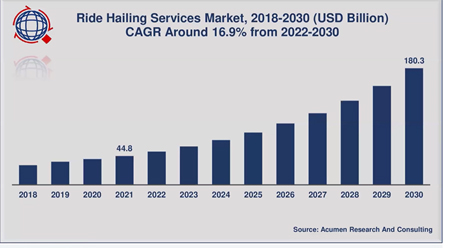
The ride hailing services market is growing at about 17% per year.
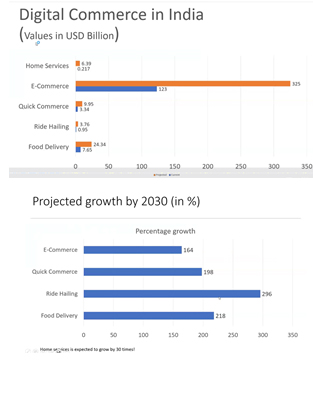
The digital commerce market in India is exploding.
The players
There are four main players:
Customers
Gig Workers
Sellers
Tech platform
Customers
The main triggers have been:
Pandemic: It converted ecommerce into a compulsion. Today, there is no compulsion, but it has become a necessity.
Smart phones
UPI
Today the customers are a pampered lot. The platform will bend backwards to keep them happy.
Gig Workers
They hold ecommerce together by taking care of the last leg. Some 3 crore workers are estimated to be involved.
The term gig worker comes from the 1920s jazz musicians. They did not have a permanent job. India is no stranger to gig workers. Signboard painters are a good example.
The pandemic saw many people like school bus drivers losing their jobs. For them the gig economy came to their rescue.
In general, gig workers can be divided into those working online and those doing the physical delivery. Dr Vandana’s talk focused on the delivery people.
Sellers
Many small sellers have joined the platform to improve their scale and reach. But they have also faced frustrations and disappointments while dealing with the likes of Amazon.
Platforms
The platforms have the power. They call the shots.
The plot
The entire story can be described as one of privilege, power and precarity. The customers are in a position of privilege. The platforms have the power. They can control information and the way the workers operate. The workers and small businesses are in a precarious position. There is no job security for gig workers. Their working hours are long. They roam around on the roads negotiating mad traffic. They do not have any insurance cover. Small businesses like restaurants are difficult to run successfully.
The nine chapters in Dr Vandana’s book cover the emotions of the different actors: freedom, oppression, pleasure, guilt.
Q&A
Dr Vandana grew up in Delhi and studied economics at Lady Sriram College. After finishing her MBA at IIMA, she worked with Standard Chartered Bank, ICICI Bank and HT Media.
Dr Vandana has always enjoyed writing. She contributed to middle columns in TOI. During her HTA days she was a columnist for Mint. It was while working in HTA that she saw the rural- urban transition taking place in greater NOIDA. That led to her book Urban Villager. She became interested in development and moved out of the corporate sector. She realized that a lot of things were happening outside the corporate world. When her family moved to France, she completed her PhD.
During the pandemic despite the tough conditions, she saw the delivery boys working with clockwork precision. She was curious to find out more about them. Then she also started studying the other players: customers, platforms and sellers. She also extended her research to neighbouring countries in South Asia.
The pandemic was harsh on low-income people. Ecommerce has given them an opportunity to earn some income. The risk is that it is not a permanent job. One cannot be doing a gig job for years. The growth of the gig economy probably implies that there are not enough quality jobs today. Or maybe people are not interested in regular jobs. Many workers mention that they didn’t intend to be here for so many years. But they are still there because they do not have a better opportunity. Exit is difficult but entry is easy. Consider delivery persons. The skills are low level. One just needs to have a two-wheeler. The country is losing the opportunity to get more out of these people.
A lot of it is about creating better jobs. We must stem the urge to automate everything. Some things do not need technology. It is frustrating for customers to deal with a bot when they have a problem. The bot can only give scripted answers and does not have contextual understanding. We must create jobs based on human skills instead of blind automation.
Sometimes we are unhappy with an Amazon product, but Amazon may refuse to provide a refund because it is a third-party seller. There is no human in the loop. So, when customers face a problem, it becomes difficult to address them.
We should also take a relook at jobs that are uplifting society. Consider teachers. They should be paid more and also trained better. We must revamp our vocational education. The ITIs are not in good shape. They are providing outdated skills. Focused skill development is the need of the hour.
Gig workers typically earn about Rs 40,000 per month. That is not bad. However, if we consider their EMI payment, fuel expenses and so on, they may be left with only Rs 25,000. But more than the money, what is worrying is the long hours of work: 10-12 hours or more. Riding a bike for such a long period of time can take a heavy toll on their health. Moreover, these workers do most of their work alone. There is limited social interaction.
What we need is legislation that enforces minimum wages, number of hours of work, insurance and safety in the workplace. Gig workers should not be given just variable pay. If there is a fixed component, they will have some sense of security and may reduce the number of hours they work.
Gig workers continue to complain. Dr Vandana has heard Uber drivers talking to their friends about the problems they face -customers not coming on time, wrong location, etc. The cars are also dirtier these days. This is because drivers work long hours and even sleep in the car to make more money. They find the platform exploitative and are often tempted to work offline to avoid paying a commission to the platform owner. They have also not received any compensation for the petrol price hike.
In the neighbouring countries, the market is relatively small. But the customers who use the ecommerce apps are excited. Of course, Pakistan and Sri Lanka are stressed economies. Nepal depends heavily on remittance money. But overall, gig workers in these countries are a happy lot. They realize they would otherwise be unemployed. In European countries like Spain and France too, the workers are quite happy as the labour laws offer good protection. In fact, the debate in Europe has moved to more advanced topics such as algorithm transparency.
Various states are taking the lead in putting in place welfare policies for the gig workers. They include Rajasthan, Karnataka, Jharkhand, Telangana and now Tamil Nadu. The proposal is to have a tripartite board consisting of the platform, the workers and the government to sort out the various issues and oversee the ecommerce industry. Of course, gig workers have their own associations and unions. The union leaders of Hyderabad have been the most vocal. There is one chapter in the book, Courage which has covered how the union leaders have brought out the issues into the open.
One participant suggested that 10 minutes for delivery (which companies like Zepto promise) is an unrealistic deadline. Delivery boys try to speed their bikes to meet the deadline. This is dangerous for them as well as for other people on the road. Even food has joined the bandwagon. We must ask what kind of food can be prepared in 10 minutes. In one of Dr Vandana’s conversations, a professor in Sri Lanka remarked: what will people do in the remaining time?
Ironically, medicines which may be needed urgently are not being delivered so fast.
Maybe increasing the delivery time will force us to go the nearby kirana stores. That will be good for the small shopkeepers.
They are losing out because of the platforms. What can we do about this? The real competition comes from Quick Commerce. The Union Minister, Mr Piyush Goyal has mentioned that thousands of shops are closing because of the platforms. So, the problem has been acknowledged at the highest level. However, no solutions are in sight.
They are not far behind. Many manufacturing activities take place in rural areas. Every small player wants to be a part of a large platform, (FOMO factor: the fear of missing out) but typically, they have many grievances. Dr Vandana gave the example of a spice seller from a Tier 4 town in Kerala. Once he was on top of the listing. Very soon, he moved to the bottom. He had no clue how it happened.
Unless the government wakes up and does something dramatic, the power of the tech platforms will continue to grow. Customers will remain pampered.